The Mandinka, descendants of the Mandeng peoples of western Africa, now reside primarily in Senegal, Gambia, and Guinea-Bissau. Among the Mande people in general, rhythm expressed as Drumming is linked with all forms of movement, be it dancing, wrestling, procession, or agricultural labor.
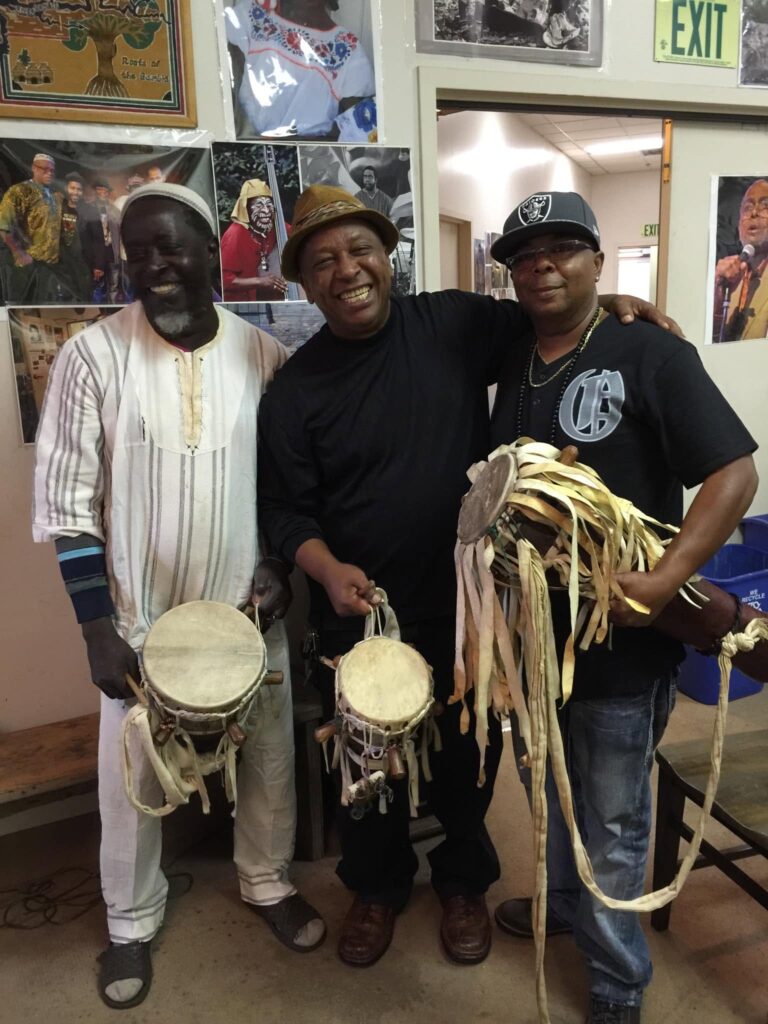
!! Each Drum is played with one hand and a short stick approximately nine inches long; the two Kutiro (Junkuran) Drums are sometimes played with both bare hands. The minimal vocabulary necessary to play the Drums consists of two different hand strokes and two different stick strokes. The hand strokes are an open bounce (kun) where a clear tone is produced and closed damped stroke (Ba) where the fingers press on the head and remain there. The stick strokes are a bounce (Din) and a press (Da). With two hand sounds and two stick sounds on each Drum, a strikingly full orchestral sound can be created by just the two Kutiro (Junkuran) Drums.
The Drum call begins all ceremonies. The Drums speak the opening prayer and request blessings for the dance ceremony to begin. The purpose of the Drum call is to contain the spirits that would normally be invoked through the dances. The Drum call is also called “Baque.” Each ethnic group has its own “Baque,” and within each ethnic group every family has its own special rhythms that are passed down from generation to generation.
The Mandinka Drum Ensemble consists of 3 Drums. The leader plays *Sabaro (Belengo) = Fabakary Badjie *Kutiribaa (Junkuran Baa) = Alassana Camara – Salif Mane *Kutirindingo (Junkuran Ding) = Yafaie Colley – Bolong Sonko *(Donkilo Jalo) = Alfuseni Jarju
